
Odoo and the transformation of industries: why this ERP is becoming one of the most important platforms for the future of business
In this blog, we will explore how Odoo is positioning itself as one of the most important ERP platforms for the future of industries, driving automation, business integration, and digital transformation within companies seeking to operate more agilely, intelligently, and efficiently.


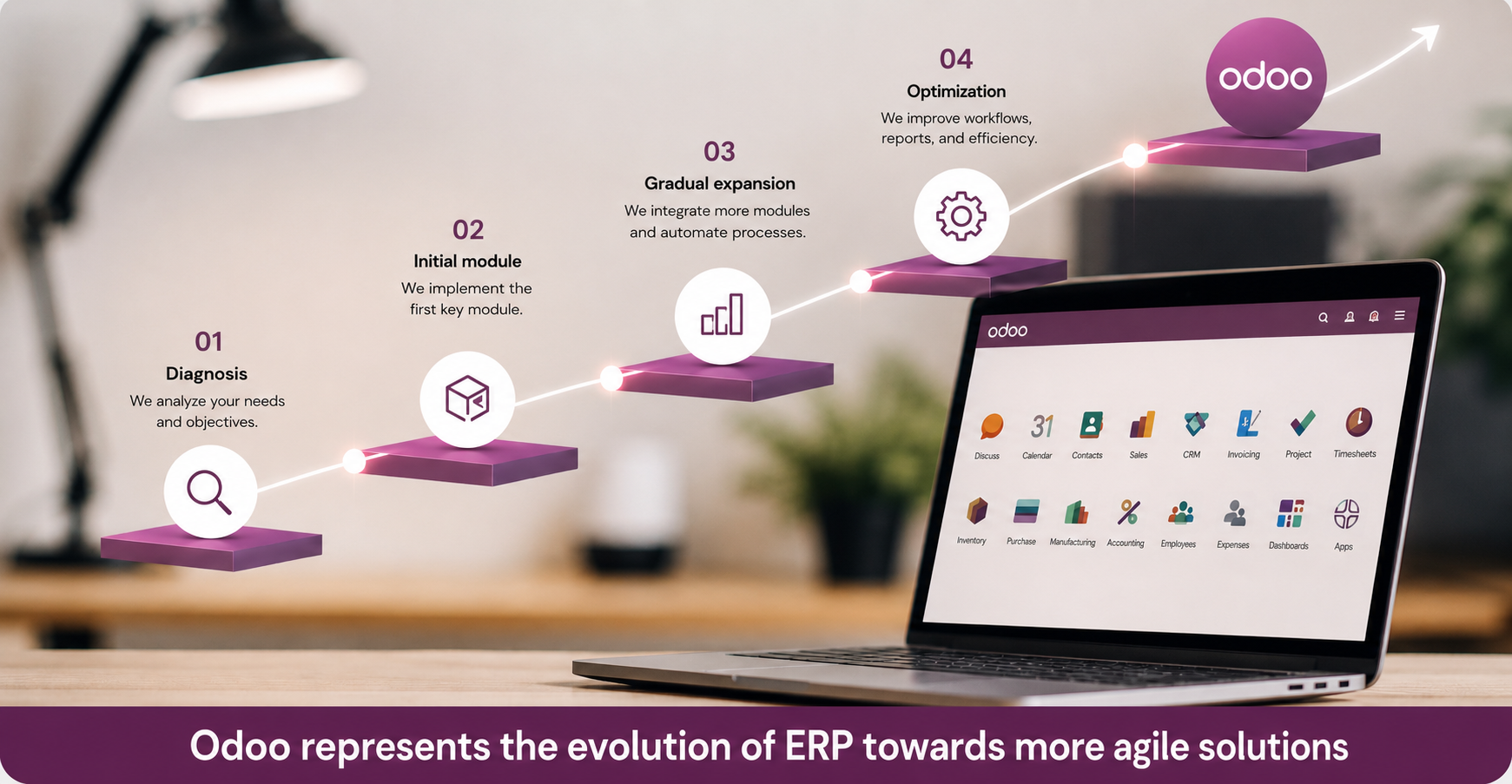
For years, ERP systems were perceived as complex tools reserved for large corporations. Implementing one involved lengthy projects, high investments, and rigid processes that often forced companies to adapt to the system, rather than the other way around. However, the business environment changed radically over the last decade. Industries began operating under constant pressure to be faster, more efficient, and more flexible. In this context, a new need emerged: for platforms that could integrate operations, automate processes, and enable real-time decision-making without sacrificing agility.
This is precisely where Odoo began to gain relevance.
What was initially seen as a modular and accessible alternative to other traditional ERPs is now consolidating its position as one of the fastest-growing business management platforms with the greatest potential across various industries. Its evolution no longer solely addresses administrative needs. Odoo is positioning itself as a strategic tool for manufacturing, retail, logistics, services, distribution, and companies undergoing accelerated digital transformation.
In 2026, Odoo's growth not only reflects the expansion of a software. It reflects a deeper shift in how companies understand business technology: less rigidity, more integration, more automation, and greater adaptability.
The Industrial Shift That Drove the Need for Platforms Like Odoo
Today's industries operate in a much more complex environment than ten years ago. Supply chains are more volatile, customers expect immediate responses, and decisions must be made virtually in real-time. In this context, traditional operating models began to show significant limitations.
Many companies grew by using multiple separate tools: one system for sales, another for accounting, spreadsheets for planning, independent platforms for inventory, and additional software for reporting or human resources. While this model might work in early stages, it becomes unsustainable as operations grow.
Technological fragmentation began to create critical problems:

The problem wasn't just technological; it was operational and strategic. Companies needed platforms capable of integrating processes and offering a unified view of the business.
This is where Odoo began to stand out.
Why Odoo started gaining ground over other ERPs
Odoo's growth was no accident. Its adoption is directly linked to an evolution in business priorities.
While many traditional ERPs continued to focus on complex implementations and rigid structures, Odoo developed a different approach:
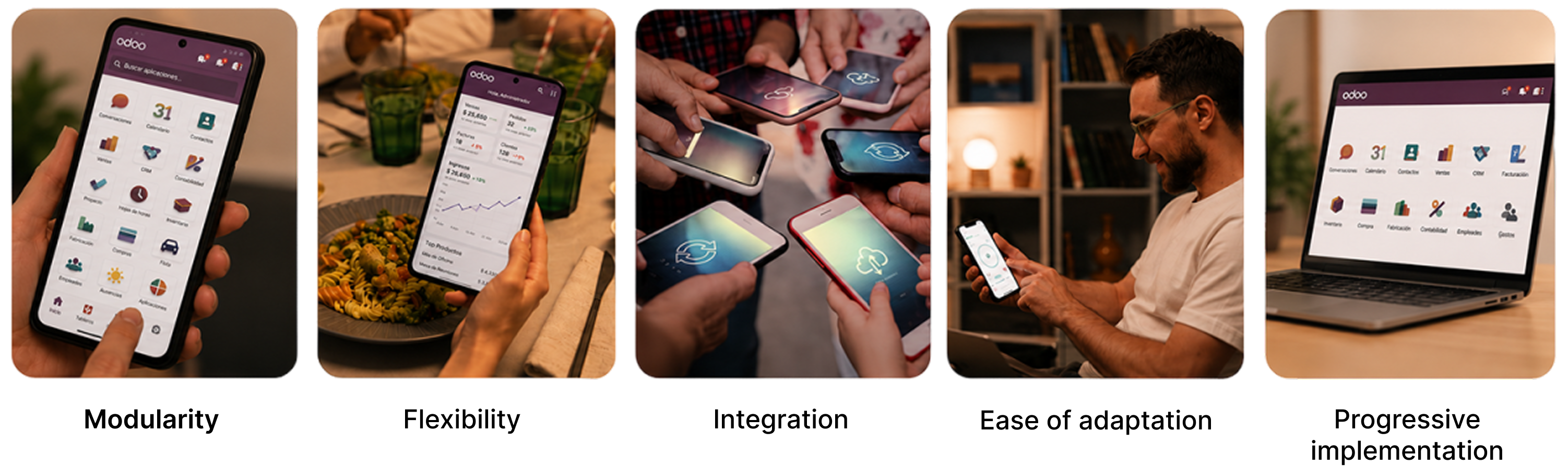
This allowed medium and large businesses to start seeing it as an alternative more aligned with current market needs.
Furthermore, Odoo achieved something significant: lowering the barrier to entry into the ERP world. Many organizations that previously couldn't afford or justify enormous projects began to gradually adopt Odoo, first implementing critical areas and then expanding.
This flexibility has been one of the main drivers of its growth.
According to recent ERP market statistics, the cloud ERP segment continues to expand rapidly and is projected to grow from $76.17 billion in 2026 to over $207 billion by 2034, with a compound annual growth rate exceeding 13%.
Odoo in manufacturing: the evolution towards smart factories
One of the sectors where Odoo is having the greatest impact is manufacturing. For years, many industrial plants operated with disconnected systems, poor traceability, and a strong reliance on manual processes.
Today, the manufacturing industry faces entirely different challenges:
- supply chain disruptions
- cost pressure
- need for real-time traceability
- flexible production
- data-driven decisions
Traditional operating models are no longer sufficient.
According to recent analyses on smart manufacturing, modern manufacturers need platforms capable of integrating production, inventory, maintenance, quality, and finance within a single digital environment.
This is where Odoo is becoming a key player.
Odoo's manufacturing module connects production orders, inventory, maintenance, and purchasing in real time. This improves visibility and allows for the detection of operational issues before they impact production.
But most importantly, Odoo no longer functions solely as an administrative system. With the integration of artificial intelligence and automation, it is evolving into platforms capable of:
- predicting demand
- optimizing production
- reducing waste
- automating operational decisions
In other words, Odoo is helping to transform traditional factories into smart factories.
Odoo and the total integration of business operations
One of the biggest problems in modern industries is the lack of connection between departments. Finance works with different information than operations. Sales uses different data than logistics. Production relies on manual reports.
This creates organizational friction and slows down decision-making.
Odoo has gained relevance precisely because it addresses this problem with a unified architecture. Its ability to integrate multiple processes within a single platform allows information to flow automatically between departments.
When a sales order is generated:

This eliminates much of the manual work and significantly improves traceability.
The business demand for integrated platforms is one of the strongest trends in the current ERP market. Various analyses indicate that organizations are abandoning fragmented ecosystems to migrate towards unified platforms that enable end-to-end operational control.
Artificial Intelligence: Odoo's Next Big Leap
Odoo's most significant evolution is likely happening around artificial intelligence.
Historically, ERPs were reactive systems: they recorded information after something happened. Today, AI integration is completely changing that logic.
By 2026, ERP trends point towards platforms capable of:
- generating predictive analytics
- automating decisions
- detecting anomalies
- anticipating demand
- optimizing real-time operations
Odoo is rapidly advancing in this direction.
Various recent implementations and analyses show that Odoo is already incorporating intelligent automation, AI-powered assistants, and predictive dashboards within its ecosystem.
This transforms the ERP from an operational tool into a business intelligence platform.
Odoo and the Future of Industries
Industries are entering a phase where adaptability will be more crucial than size. The companies that survive and thrive will be those capable of responding quickly to changes in demand, market, and operations.
This is where flexible platforms like Odoo have a significant advantage over traditional models.
While many legacy ERPs were designed for rigid structures, Odoo was built with a modular and scalable logic. This allows it to adapt much better to:

Furthermore, the growth of cloud ERP and API ecosystems is favoring more open and integrable platforms. According to ERP 2026 trends, companies are prioritizing cloud-first solutions, advanced automation, and connected architectures.
All of this directly supports Odoo's technological model.
Odoo's Impact on Mid-sized and Growing Businesses
One of Odoo's most interesting aspects is that it's democratizing business capabilities that were previously reserved for large corporations.
Many mid-sized companies historically operated without ERP because:
- they were too expensive
- too complex
- too rigid
Odoo changed that paradigm.
Today, mid-sized companies can access:
- advanced automation
- integrated analytics
- centralized operational control
- digital processes
- business integration
without the need for massive projects.
This is accelerating the digitalization of multiple industries.
The future of ERP will no longer be solely administrative
The concept of ERP is changing.
In the past, ERPs were seen as administrative tools. In the future, they will be intelligent platforms capable of connecting data, automating processes, and supporting strategic decisions.
Current trends point towards:
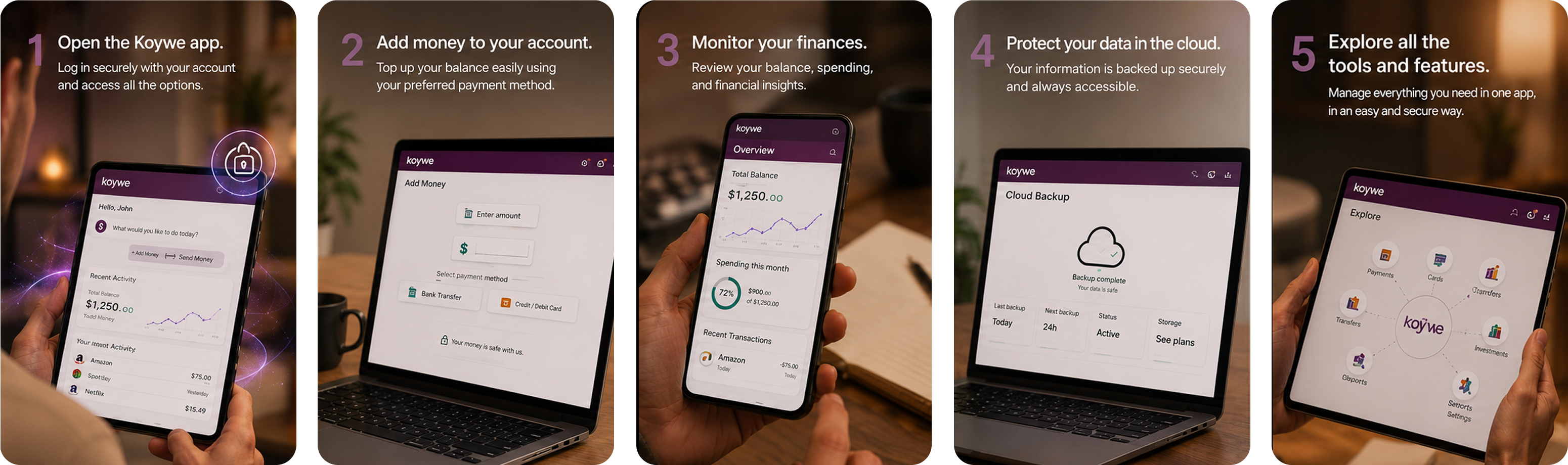
Odoo is directly aligned with this evolution.
Its open, modular, and flexible architecture positions it as one of the best-prepared platforms for the next cycle of business transformation.
Conclusion
Odoo's growth reflects something much deeper than the expansion of an ERP software. It reflects a structural shift in how industries understand business technology.
Organizations are no longer just looking for administrative systems. They are seeking platforms capable of integrating operations, automating processes, generating visibility, and adapting quickly to an increasingly complex business environment.
Odoo is successfully positioning itself within this new reality because it combines:
- flexibility
- integration
- scalability
- automation
- and technological evolution capabilities
In a context where industries need to be more agile, smarter, and more connected, Odoo is not just helping to improve current operations. It is helping to build the operational future of businesses.