
Digital Transformation in 2026: Why companies that don't evolve this year will be left out of the market
In this blog, you will discover what it really means to transform digitally in 2026, why many projects fail and how technologies such as ERP, AI and solutions such as Odoo and SAP are redefining business operation.


2026 is not “just another year” for Digital Transformation

Over the past decade, digital transformation was presented as a competitive advantage. There was talk of innovation, disruption and “preparing for the future”. In 2026, that discourse no longer applies. Today, digital transformation ceased to be an aspiration and became a minimum condition for continuing to operate.
Companies aren't just competing against other companies in their industry; they're competing against operating models that are more agile, more efficient and deeply supported by technology. Those who fail to adapt to this new context not only lose the market: they lose relevance.
This article does not seek to repeat generic definitions or superficial tendencies. Its objective is to explain what it really means to transform digitally in 2026, why so many projects fail and how organizations can approach this process in a realistic, measurable and sustainable way.
The Business Context in 2026: More Pressure, Less Room for Error

Organizations starting 2026 do so under a particularly demanding scenario. Unlike previous years, where growth could be sustained by commercial expansion or aggressive investment, today the focus is on operational efficiency, cost control and the generation of tangible value.
Boards of directors and financial departments no longer approve technological projects solely because of promises of innovation. Every initiative must justify its impact on productivity, profitability or risk reduction. This has radically changed the way in which digital transformation is conceived.
In addition, customers—both B2B and B2C—have become less tolerant of friction. They expect agile processes, real-time information, short response times, and consistent experiences. When a company cannot meet these expectations, the market doesn't wait: it simply seeks another option.
In this environment, digital transformation is not an isolated project, but rather a strategic response to a context that has already changed.
Digital Transformation: Redefining the Concept by 2026
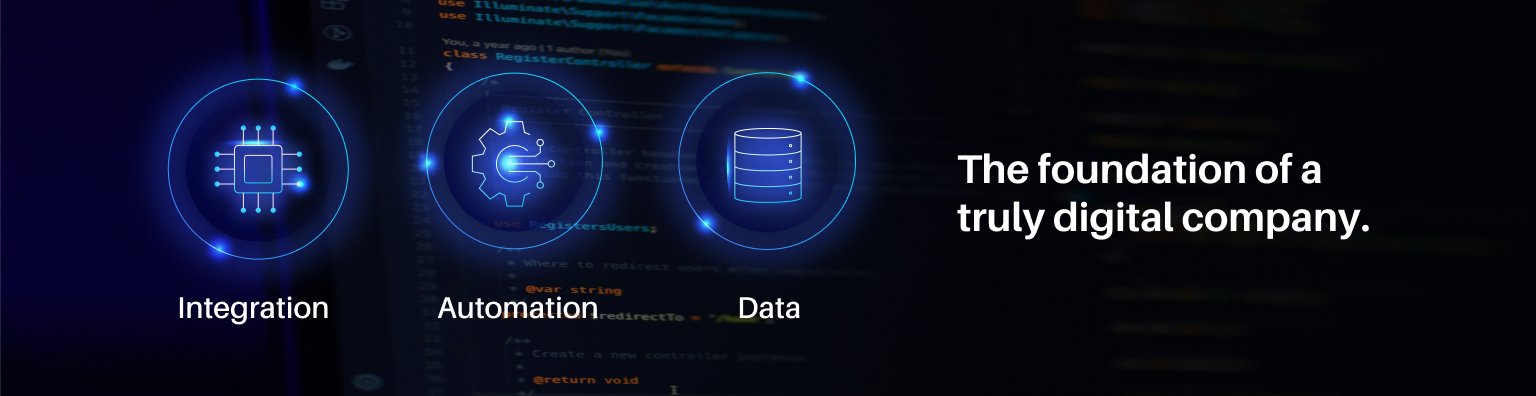
One of the main problems faced by companies is that many believe they are in a process of digital transformation when in reality they are only digitizing parts of their operation. The difference is subtle, but critical.
Digitizing involves bringing existing processes to technological tools, often without questioning whether those processes are still efficient. Digitally transforming involves something much deeper: rethinking the way in which the organization operates, makes decisions and delivers value, using technology as an enabler.
In 2026, digital transformation is characterized by three key elements. The first is integration. Systems can no longer operate like islands. Information must flow between areas, platforms and levels of the organization. The second is intelligent automation, not only to reduce operational load, but to eliminate errors, improve times and free up human capacity. The third is the strategic use of data for decision-making, leaving behind intuition as the main driver.
When these elements are not aligned, the transformation becomes superficial and, in many cases, costly.
Why Most Initiatives Fail
Despite increasing investment in technology, a large part of digital transformation projects do not achieve the expected results. This is not due to a lack of tools, but because of structural errors in the approach.
One of the most common mistakes is to start the transformation from the technology and not from the business. Many organizations start by selecting an ERP, automation platform or analytics solution without having clearly defined what problem they are looking to solve. As a result, they end up adapting their operation to the tool instead of the tool enabling better operation.
Another critical factor is the lack of internal alignment. Digital transformation is not the sole responsibility of the IT area. It involves operations, finance, human resources, general management and, in many cases, external suppliers. When there is no shared vision, projects are fragmented and lose impact.
Finally, there is the issue of talent. Implementing technology without adequate capabilities to operate, adapt and evolve it is one of the main causes of failure. Digital transformation isn't sustained by software alone; it's sustained by people who understand both technology and business.
The Role of ERP in Modern Digital Transformation

In 2026, ERP systems remain at the core of business operation, but their role has evolved significantly. It's no longer just about keeping accounts or controlling inventories. Modern ERPs work as integrative platforms that connect processes, data, and equipment.
A well-implemented ERP allows the organization to have real-time visibility over its operation. This means that decision-making is no longer based on historical reports and is based on up-to-date and reliable information. In addition, it facilitates the automation of critical flows, reducing execution times and human errors.
However, the value of ERP is not in the system itself, but in how it adapts to the reality of the business. In many cases, companies fail because they try to replicate legacy processes within the ERP, instead of taking advantage of the implementation to redesign the way they operate.
This is where flexible solutions such as Odoo or custom-made SAP implementations become relevant. They allow the technology to be adjusted to the business model, instead of forcing the business to fit into a rigid structure.
Automation and Efficiency: Beyond Cost Savings

One of the great myths of digital transformation is that its main objective is to reduce costs. While economic efficiency is an important benefit, in 2026 the true value of automation lies in the ability to scale and adapt.
Automating processes allows the organization to respond more quickly to changes in demand, to new regulations or to market opportunities. It also reduces dependence on key people for operational tasks, reducing risks and bottlenecks.
In addition, automation frees up time for teams to focus on higher-value activities, such as analysis, continuous improvement or innovation. This change in approach is essential for digital transformation to have a real and sustainable impact.
Artificial Intelligence: from promise to practical use
Artificial intelligence has ceased to be a futuristic trend and has become an everyday tool in many organizations. In 2026, its adoption is no longer measured by isolated experiments, but by its integration into key processes.
AI is used today to optimize supply chains, improve financial planning, automate customer service, and support decision-making. However, its effective implementation requires quality data and well-defined processes. Without these elements, AI doesn't create value and, in some cases, it even increases operational complexity.
It's important to understand that AI doesn't replace strategy or human judgment. It works like an accelerator that powers existing capabilities. Therefore, its adoption must form part of a larger transformation strategy and not as an isolated initiative.
The Human Factor: The Most Underrated Link
No digital transformation is successful without appropriate change management. People are the ones who adopt, use and take advantage of technology. When their needs, resistances and capabilities are not considered, even the best technological solution fails.
In 2026, the most advanced organizations understand that talent is a strategic enabler. It's not just about hiring more staff, but about having the right profiles at the right time. This is where models such as strategic IT Staffing play a key role.
Having project specialists, fractional technology leaders or hybrid teams can accelerate transformation initiatives without inflating structures or assuming unnecessary permanent costs. This approach provides flexibility and reduces risks, especially in complex or highly uncertain projects.
How to start an effective digital transformation in 2026

A well-executed digital transformation starts with an honest diagnosis. Before selecting tools or vendors, the organization must understand where it is and where it wants to go. This involves analyzing processes, identifying inefficiencies and defining clear and measurable objectives.
Based on this diagnosis, it is essential to prioritize initiatives. Not everything can be transformed at the same time. Successful companies focus their efforts on areas with high impact and visible results in the short and medium term.
Finally, technology must be selected as a response to these priorities, not as a starting point. ERP, automation, analytics and artificial intelligence must align with the business strategy and have the necessary talent for its correct implementation and evolution.
Conclusion: 2026 as a turning point
Digital transformation in 2026 is not a fad or an optional project. It is a strategic response to a business environment that has already changed. Organizations that understand this and act with clarity, focus and discipline will be better positioned to grow, adapt and compete.
Those who continue to approach transformation as a series of disconnected technology initiatives are likely to face frustration, cost overruns and limited results.
Digitally transforming today means building an organization that is more efficient, more agile and more prepared for the future, using technology as an ally, not as an end in itself.